


Our methodology
Finapolis turns dense, dispersed financial data into research you can act on, and every step is built to be auditable. Each insight traces back to the filings, market data, and macro inputs that produced it, so you can verify the work rather than take it on trust. This page walks through how the pipeline runs, from raw data to a sourced conclusion.
How our research pipeline works
The methodology runs in 5 connected stages that move raw financial data to a sourced conclusion. Each stage is built for transparency and verification, so you can see how a conclusion was reached and which sources informed it.
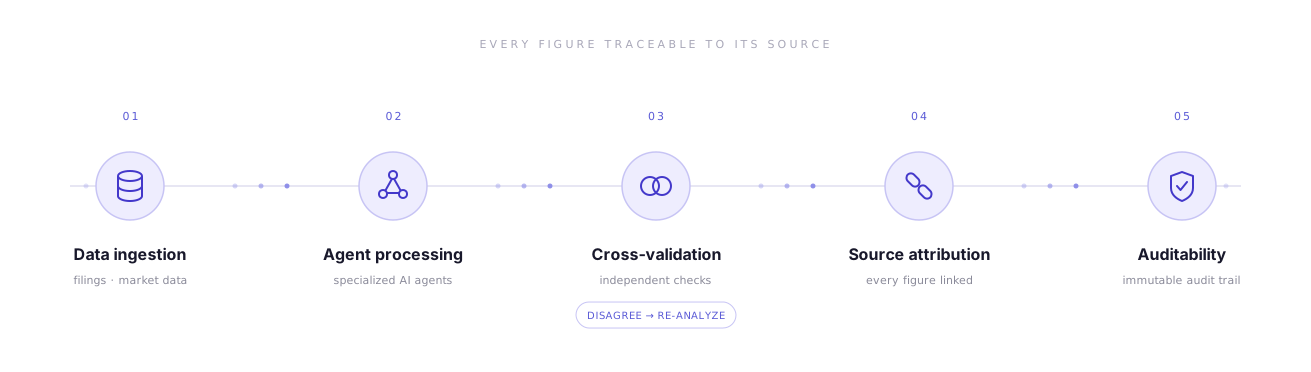
Data Ingestion
Finapolis aggregates financial data from institutional-grade providers: Massive for market data, Tiingo for fundamentals and financial statements, FRED for macro series, and the SEC EDGAR system for regulatory filings and earnings transcripts. Each data point is timestamped and tagged with its source the moment it enters the system, so every figure carries a trail back to where it came from.
Raw data is kept alongside the processed version. That lets any earlier analysis be reproduced exactly as it was generated, while the models always work from the most current data.

Key Principle: Source Preservation
Every data point keeps a permanent link to its original source, timestamp, and version. That record is the foundation of the auditability guarantee.
Agent Processing
Rather than rely on a single model, Finapolis runs a multi-model pipeline in which each model is specialized for a part of the work. One model drafts the analysis. Another breaks that draft into its smallest verifiable claims, so each statement can be checked on its own.
Every model logs its reasoning, the sources it consulted, and a confidence level for each conclusion. That separation improves accuracy through specialization and produces a clear attribution chain you can inspect during a compliance review or an investment committee discussion.
Key Principle: Transparent Reasoning
Every conclusion ships with a record of the reasoning steps, the data consulted, and the alternatives considered, so you can judge the quality of the analysis, not just the answer.
Cross-Validation
Before an insight reaches you, every claim is fact-checked against the source documents in 3 escalating phases. The first pass checks each claim against the most relevant passages. The second re-checks anything quantitative against the exact figures in the filings. The third sends unresolved or disputed claims to a higher-reasoning model that issues a final verdict and, where a claim is wrong, a minimally corrected revision.
Claims that pass cleanly move on; the rest are corrected and re-verified until the text and its evidence agree. Disagreements are resolved against the source, not averaged away.
Key Principle: Independent Corroboration
Claims are confirmed against the underlying filings and transcripts by multiple independent passes. Conflicts are escalated and resolved, not quietly smoothed over.
Source Attribution
Every insight, metric, and claim carries explicit source attribution. Open any analysis and you can drill down to the exact SEC filing, transcript, or data feed behind each element, with a link to the original document wherever one exists.
That granularity does real work: it lets you verify independently during due diligence, it supports compliance documentation, and it shows the output is sourced from primary documents rather than guessed at.
Key Principle: Complete Traceability
No insight is presented without a path back to its source. Every conclusion traces to the specific documents, data points, and timestamps that informed it.
Auditability
Every analysis can be reproduced exactly as it was generated, even months or years later. Finapolis keeps versioned snapshots of the data, the model state, and the verification logs.
That consistency over time is what compliance reviews and investment committee records depend on. The audit logs are immutable and tamper-evident, which gives compliance officers and outside auditors a record they can trust.
Key Principle: Temporal Integrity
Historical analyses stay reproducible indefinitely. Audit logs are immutable and complete, so past decisions can be reviewed with full context.
Limitations of Our Methodology
The pipeline is built for transparency and accuracy, but it has limits, and we would rather state them plainly. However rigorous the verification, the models are probabilistic systems that find patterns in historical data. They cannot foresee shocks or regime shifts that fall outside that data.
Source attribution and auditability show how a conclusion was reached. They do not guarantee it is correct. Data providers publish errors, filings contain misstatements, and even a fully verified claim can be wrong if the underlying data or assumptions are flawed.
The models also improve over time. Historical versions are preserved for auditability, but an analysis run today can differ from one run last month on the same data, because the models behind it have changed.
Finapolis is a research tool built to support professional judgment, not replace it. Make every investment decision with appropriate due diligence, risk assessment, and advice from a qualified professional.
Learn More About Our Platform

Data Sources
Review our complete list of data providers, update frequencies, and coverage details. Understand the breadth and depth of information powering our analysis.
View Data Sources
Trust & Security
Understand how we protect your data, maintain platform security, and ensure regulatory compliance.
Learn MoreSee the pipeline in action
Put the research methodology to work on a company you care about. Start a free trial or book a demo with our team.